


Develop rhythm and adjustability with Caroline Powell’s simple exercise
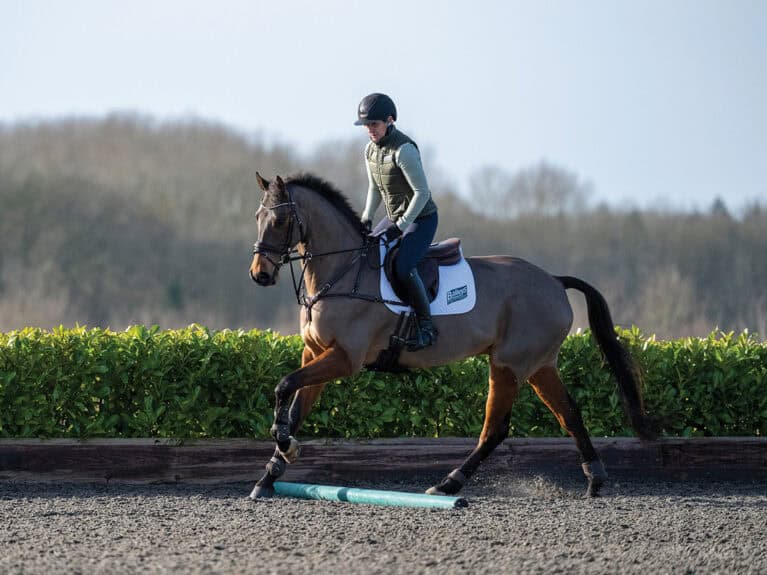
Our expert: Caroline Powell is a Suffolk-based event rider. She’s represented New Zealand in two Olympic Games and two World Games and, in 2024, she won Badminton with Greenacres Special Cavalier.
Successful jumping is all about getting the right canter rhythm – once you have that, everything else should fall neatly into place. In my new series, I’m going to talk you through three exercises that will help you find your flow. So, not only will you have a higher chance of jumping clear, but your rounds will also be more comfortable to ride and look effortless.
Up first is a clockface exercise. We’re going to start off by working on your horse’s natural rhythm and then add some adjustability within the pace.
Set it up
You only need four poles and space to create a 20m circle for this exercise. Place one pole on each quarter of your circle – walk the line between each one, making sure the distances are equal so your horse can comfortably fit in four strides in each quarter.
Getting started
The aim is to ride through this exercise in canter, but start off in walk and then have a go in trot to introduce your horse to the poles, as they come up quickly. As you ride around, keep a natural rhythm and simply focus on riding the line.
Depending on your horse’s stamina and strength, ride through a few circles at a time, go large to give him a chance to rest and process, then repeat the exercise on the other rein.
Next-level skills
Once you’ve established the exercise in canter on four comfortable strides, it’s time to practise adjustability. The aim is to be able to move your horse forward and bring him back using your bodyweight and position as your aids, but he might need a little more guidance from your leg and rein contact to start with.
Have a go at riding…
- four strides in each quarter for one circle
- then ride five strides between each pole for one loop
- open up again to ride four strides for one half
- then, finally, five strides for one half of the circle
Changing the intervals of when you ask your horse to shorten or lengthen his stride will help prevent him from predicting the next move and encourage him to listen more carefully to your aids.
Simple changes
When asking your horse to lengthen his stride, avoid restricting him by adopting a lighter seat (you don’t need to be in a two-point position, just keeping your weight out of the saddle slightly), softening your rein contact and squeezing with your legs to encourage him to travel forward in a natural rhythm.
How to ride it
This exercise is quite challenging for your horse, so he might try to find ways of making it easier, which means you need to keep things clear and consistent and support him to the best of your ability.
- Turn your head and shoulders towards the direction you’re going in and focus your eyes one step ahead
- Control the line with your outside aids to avoid too much bend. Your horse needs to be relatively straight through his body while looking around the turn, so engage your outside leg and rein to support his shoulder
- Sit in the saddle and open your hips to move with your horse and let him travel freely
10 minutes to spare
When you’re feeling ready to increase the challenge even further, try aiming for a different point of the pole – starting with the outside, then the inside. Ride through the exercise in the same way, beginning with a normal stride length and then adding in an extra stride.
Troubleshooting: rolling poles
If your horse keeps tapping the poles, this is most likely happening because you’re not reaching them on a comfortable distance for his stride. So, the first thing to do to try to correct this is assess your canter. Is your horse working actively and maintaining a clear rhythm throughout? Counting the strides out loud can help with this.
The next thing to look at is your line. Ask a friend to video you from a few different angles and consider whether you are accidentally making the circle smaller, or maybe even going too wide. Envisage the perfect circle running through the middle point of each pole and stay disciplined in your riding to achieve that line. If there is a particular point (maybe it’s when your horse is near the gate) that you’re struggling with, set out a marker to help guide you.
TOP TIP
If your horse consistently knocks poles, get him assessed by your physio and vet. It could just be a lack of strength and stamina, but it’s vital to check there are no underlying issues.
Troubleshooting: quarters in
If a horse brings his quarters in on a circle in canter, this often indicates stiffness through the back or a lack of strength: instead of placing his hindlegs further underneath his body to stay in balance, he swings his hindquarters in. Being able to spot this can be difficult, as it can be very subtle, so this is when it’s helpful to have someone on the ground. Even though your horse is constantly turning in this exercise, he needs to be as straight as possible through his body, with his hindlegs following the line of his forelegs.
To correct this, don’t rely on your inside leg to push his hindquarters back out, as this may leave you with the opposite problem. Instead, bring his shoulders in to straighten him up – this goes back to the point of using your outside aids to make the turn.
TOP TIP
If your horse is falling out through his shoulder, ‘lift’ his forehand around the turn by raising your outside rein slightly. Keep a soft inside hand to prevent overbending, too.
Always learning
As you ride through this exercise, you’ll probably have to make a few adjustments to get it spot-on, but don’t worry if things go too far wrong the other way. Learning from those mistakes will help you get it right. For example, if your horse needed more support through his outside shoulder to stay straight, but then he finds the striding difficult, you’ll know next time that you need to reduce your outside aids slightly or alter your line.
Read part two of Caroline’s series here!
Caroline is sponsored by Baileys Horse Feeds, baileyshorsefeeds.co.uk
Your Comments

Newsletter Sign-up


Subscribe
Latest Issue



Bubby Upton backs air ambulance appeal after life-threatening riding accident
Added 15th October, 2026
Load-pulling work linked to reduced spinal movement in military horses
Added 14th October, 2026

Shop