
Featured Professional
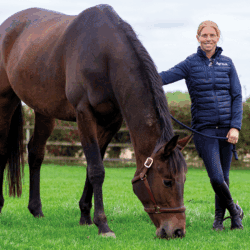
Ros Canter’s jumping tips will help improve your horse’s agility and reactivity
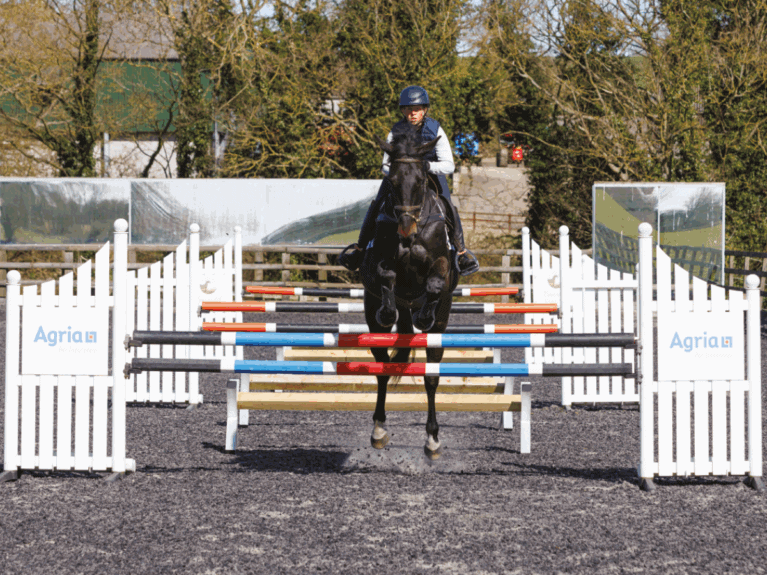
In simple terms, to achieve a clear round you need to ride disciplined lines and your horse needs the ability to jump neatly. But there are so many elements that make up yours and your horse’s ability to do just that – and that’s why it’s so important to break down your training plan to focus on specific skills.
Let’s look at your horse first. To jump well he needs to be straight, balanced and in a good rhythm, but to do that he must be strong and quick on his feet. And you as the rider have to guide him, set him up correctly and, most importantly, allow him to do his job efficiently.
In this issue, I share one of my favourite gridwork layouts that will help improve so many of these essential aspects of your horse’s jumping ability, as well as your skills in the saddle. Read on to find out more.
Set it up…
You’ll need:
- three sets of wings
- six poles
- four cavaletti
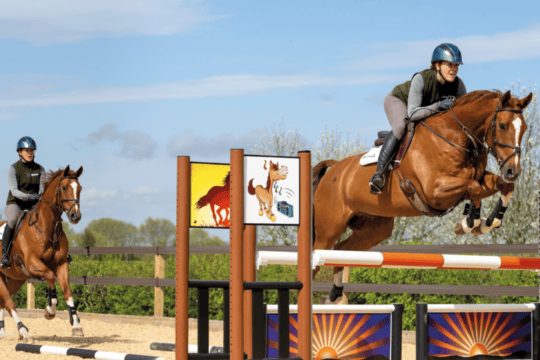
Position each fence two strides (10–11m) apart and place two cavaletti (you can use pole raisers if you don’t have any) in between the fences, approximately 3m apart depending on your horse’s stride.
This exercise is great for…
- your horse’s footwork
- stamina
- muscle development
- hoof-eye co-ordination
- reactivity
- rhythm and regularity of his paces
- establishing straightness
Step by step
Thanks to the progressive nature of gridwork, you can adapt this exercise to suit horses at every level.
If your horse is stronger and more advanced, you’ll be able to progress through the stages more quickly – although it won’t be a waste of your time working on the basics at a lower level. If your horse is less experienced, gradually increase the intensity of the grid over several sessions. You can start with just poles on the ground (with the distances adjusted), then build up to cross-poles (which will help guide your horse to stay straight) and uprights when you and he feel ready.
Whatever level you’re at, remember to listen to your horse and always try to finish on a positive note. With a challenging exercise such as this, it’s always better to finish sooner when you’re happy than push for one more and risk knocking his confidence.
The upper limit
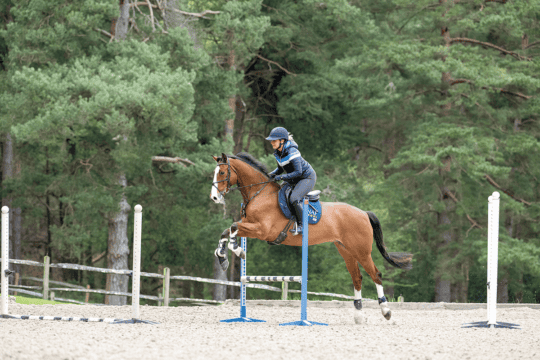
With so many fences in a row, this exercise is very physically demanding so keep the height well below what you’re competing at. For example, Louis here is out jumping 110cm courses, but we didn’t build up that high as it’s not about testing his scope – the aim is to improve his agility and reactivity.
Ros’s rider tips
Once you’re on the line towards the grid, ride with a length of rein that allows you to pick up a small fold but without the need to throw your hands forward on take-off. This will help you stay safe and in balance, and your horse will also be able to use his body because of the length of rein.
Eyeing up
Much like the exercise I used in the previous issue, the main focus of this is to help establish straightness, particularly through your horse’s body. However, it also enhances those skills we developed on the flat – using your eyes to tell your horse where to go so you can communicate efficiently and effectively.
With a set-up such as this, I can get my eyes focused on the end of the line, which encourages me to stay straight through my body and taller over fences. Doing this will subsequently allow my horse to use his body freely underneath me, so we’re both more stable and in better balance.
Essentially, once my eyes are locked on the end of the line, the rest of my body signals to my horse to stay straight – and then it’s his job to jump the fences.
Pole playground
If you don’t have enough equipment in your arena, don’t worry. There are so many variations of this grid that will provide the same benefits.
You can use poles on the ground instead of cavaletti, or just have two fences. You can also change the set up a bit – for example, placing a cavaletti before the first and after the last fences, or switching the distance to a one-strided double with just one cavaletti between the fences.
The nearest exit
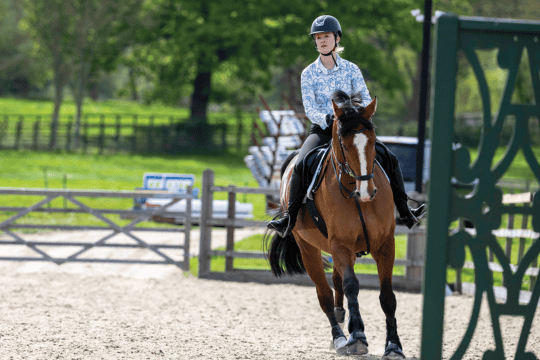
Now you’ve managed to stay straight through the grid, can you maintain it on the exit? Even if you only have two or three strides before you have to make a turn at the end of the arena, it’s wise to get into the habit of keeping straight for those all-important strides.
So, even though I set up this exercise on the long side, which meant Louis knew he was turning the same way every time, he still had to jump the last fence and stay straight for a few strides before I gave him the signal to turn. It’s all about having discipline as a rider and not letting your horse anticipate or drift.
You can always add another mental checkpoint within the exercise to help you achieve this – and it’s worth doing the same when walking and planning your lines for a course.