




Alicia Wilkinson has three must-try exercises to improve your showjumping approaches
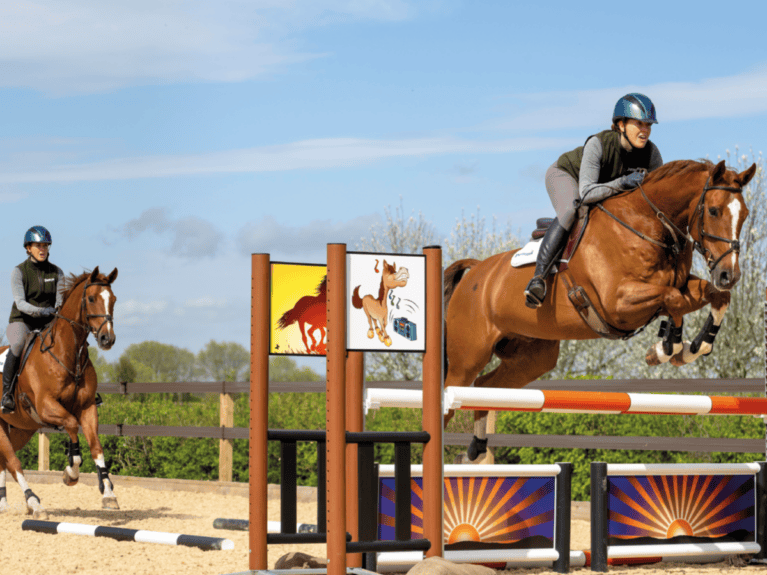
Our expert: Alicia Wilkinson is an event rider, BE UKCC Level 3 and BHS coach based in Essex. She’s competed up to 4* and runs a small team of horses from her yard at home.
A misjudged line can be the difference between a clear round and a knocked pole in the showjumping arena. The good news is, working at home to hone your skills between fences will boost your and your horse’s performances and pave the way to success over fences. Let’s get started!
Doubles
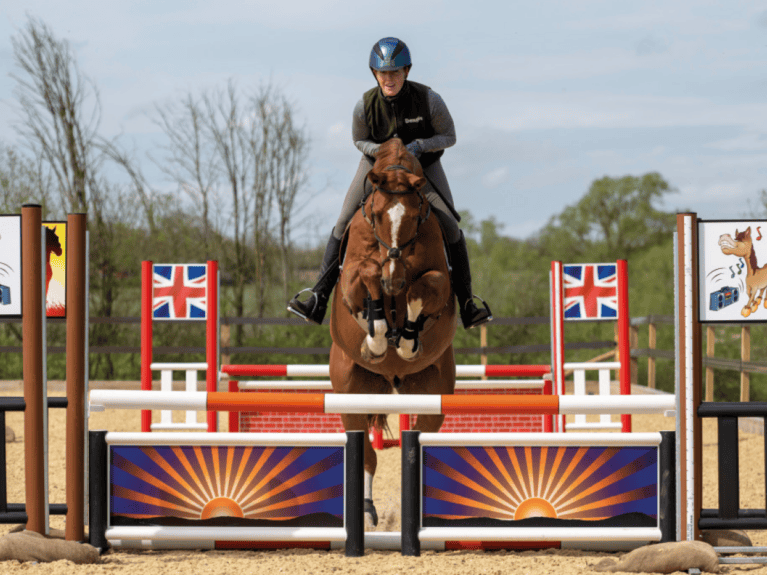
Doubles are something that crop up in every showjumping course. Making sure you have an accurate approach to the first element is what determines the success of the combination, because making the distance between the two fences requires you to jump square and straight. Practising at home is a great way to improve your straightness as a whole and ensure you ace doubles every time.
Alicia’s actions
To train for doubles, you need two fences set one (6.4–7.7m) or two (10–11m) strides apart. Then add some extra poles on the ground – create a channel between the fences using two poles set just over a horse’s width apart. You can also include another pair of poles as tramlines before the first fence and also directly after the second, which is especially helpful if your horse is inexperienced.
As you work ride this exercise, think about…
- approaching with a forward, rhythmical canter
- keeping your eyes on the first fence as you make the turn onto the line, then looking up and beyond once you’re straight
- channelling your horse with light pressure from your calves, keeping him moving forward and straight
- maintaining an even feel down the reins
The poles are there to guide you. If you find your horse is drifting, adjust your aids – using your seat and leg, rather than your reins – to help correct him.
Then start to widen the poles to test whether you can ride the double with the same level of accuracy when you don’t have as much support from them.
Level up
To make the exercise harder, incorporate a related distance by adding more strides between the fences – the longer the line, the trickier it is to keep straight.
Dog-legs
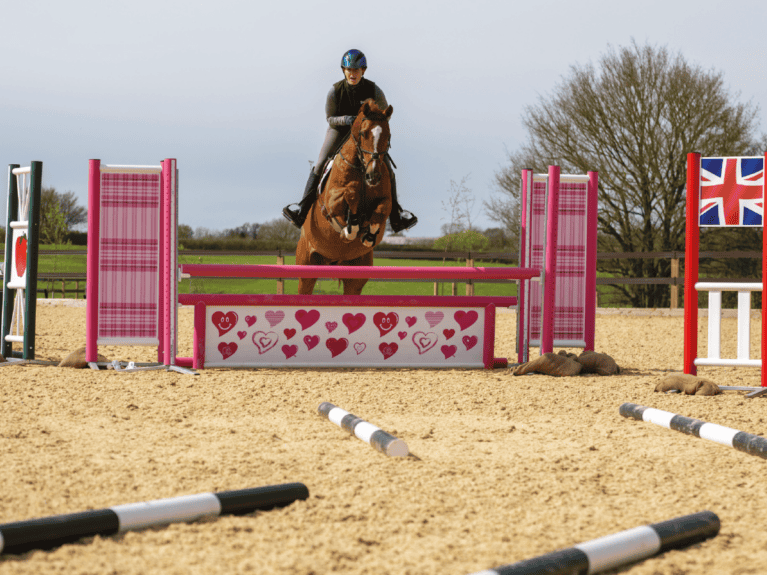
Dog-legs are essentially a related distance but with a curve or turn between the fences. Arriving at the second element on the perfect stride requires complete accuracy and good rhythm – as well as choosing and riding the perfect line.
Bear in mind that the fewer the number of strides between the fences, the harder the line, because you’ll have less time to prepare and ride the turn. You can also make the curve as shallow or tight as you like – shallower is easier, while steeper angles are more difficult.
Top tip
Try to make a habit of walking the course at a competition exactly as you intend to ride it. Take the time to analyse and choose your lines, as well as pacing out the distances.
Alicia’s actions
Dog-legs vary in terms of striding, but will have around six strides in total. So, build a fence followed by a three-stride distance (13.7–14.6m) before a turn and another three-stride distance to a second fence. When you’re first practising, use the tramlines from the previous exercise to create a path to help you and your horse get to know the timing of the turn and reduce your inclination to cut the corner.
When riding a dog-leg…
- approach the first fence head-on – staying central will give you a better chance of making the striding accurately
- as your horse takes off over the first fence, look towards the second one and don’t take your eye off it
- count your first three strides out loud – begin to prepare for the turn on stride two and start to make the turn on stride three
- support your horse around the turn by turning your upper body, using your outside rein to manoeuvre his shoulders, outside leg to support his quarters and inside leg to achieve bend through his body
- straighten up and ride square on to the second fence
Level up
Later, instead of having tramlines throughout, use a cone, wing or single pole to mark the turning point to test your ability to ride a consistent line.
Jump-off turns
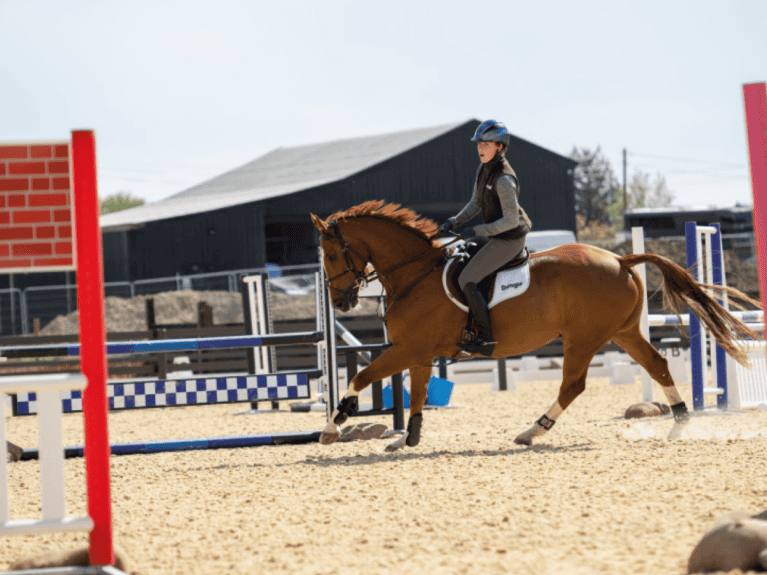
Being able to maintain rhythm and place your horse at the right take-off point while shaving off corners and saving time is the best way to climb the leaderboard.
However, it’s no good if your horse doesn’t have enough time to see and understand the next question, otherwise you risk four faults. By choosing wisely the turn you plan to tighten up, if any, you’ll avoid mishaps – but remember, sometimes, you’ll be better off going wider but upping the pace.
Alicia’s actions
You can practise your jump-off turns over as many fences as you like, but you can also ride the exercise with just two on a large circle.
To start with, keep your approach to the first fence relatively straight on and focus on perfecting your aids to ride a jump-off line. To do this…
- as your horse jumps a fence, look in the direction you’re going on landing, placing a little more weight into the corresponding stirrup to encourage him to land on the correct lead
- sit tall and turn from your hips to direct your horse – avoid dropping your inside shoulder
- lift your outside hand slightly to move your horse’s shoulders around the turn – remember to avoid pulling on your inside rein, as it’ll cause a loss of rhythm and balance
- keep pressing with your outside leg to maintain impulsion
When you feel ready, have a go at jumping the fences on an angle, which, depending on the course, might alter the angle of your turn, helping your rounds become smoother and more efficient – bonus!
Level up
If you feel confident, add half a gear more impulsion than usual and try the exercise again. The aim isn’t to unsettle your horse’s rhythm, but to add momentum and ground cover around the course.
Showjumping success
While your horse needs to learn the skills and technique to bascule neatly over fences, the quality of your lines in between each element is one of the biggest determining factors for riding a clear round. And the great thing about this is that you can do it over poles on the ground to minimise the impact on your horse. So, when it comes to putting up the fences, your skills are to hand and you’ll be ready to ace it.
Your Comments

Newsletter Sign-up


Subscribe
Latest Issue

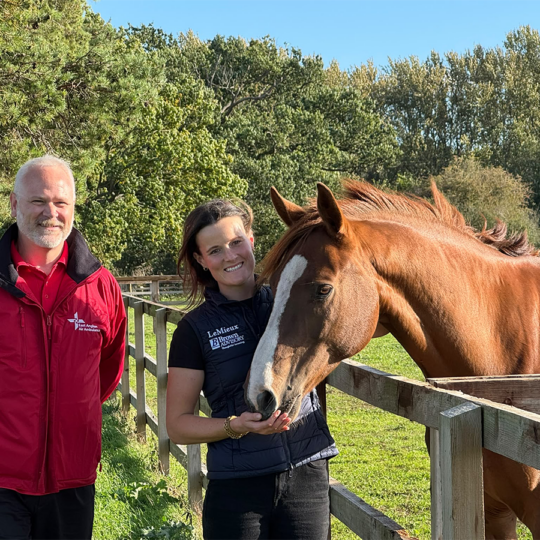
Bubby Upton backs air ambulance appeal after life-threatening riding accident
Added 15th October, 2026
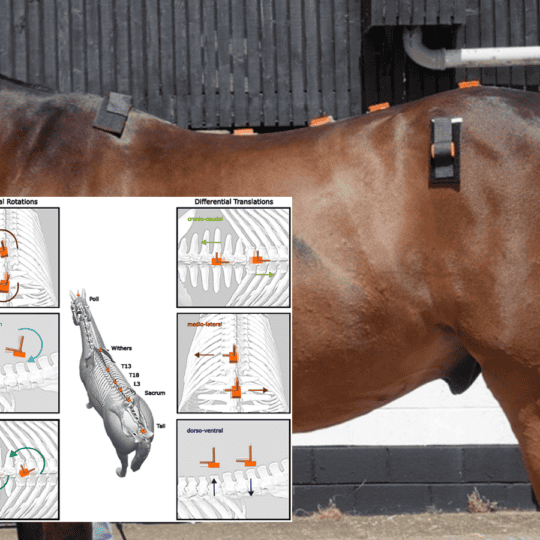
Load-pulling work linked to reduced spinal movement in military horses
Added 14th October, 2026




Step-by-step on how to hitch a trailer
Added 18th March, 2025

Winter Training: Part 2
Added 4th March, 2025